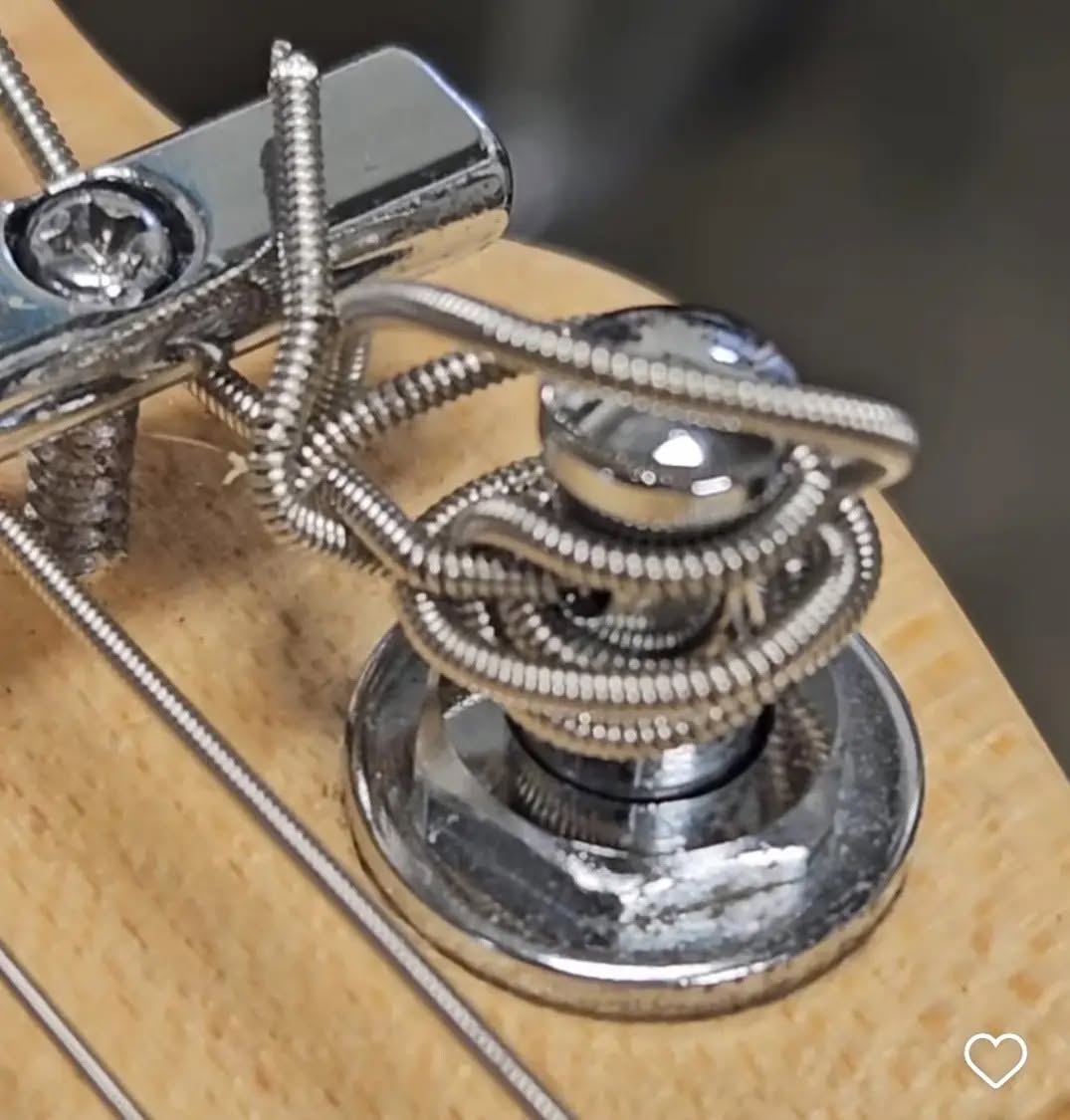
There are a lot of little rituals guitar players pick up over the years. Some of them are useful. Some are harmless. And some are just bad habits dressed up as “pro technique.”
The luthier’s knot belongs in that last category.
For some reason, the luthier’s knot has gained a reputation as the “proper” way to tie off strings at the tuning post. You’ll see people recommend it like it’s some secret old-world trick that keeps your guitar in tune, locks the string down, and makes you look like you know what you’re doing.
In reality, it is one of the most annoying, unnecessary, and overrated ways to string a guitar.
The promise is simple: wrap the string around the post, tuck it under itself, bend it back, and create a little locking knot so the string supposedly cannot slip. That sounds good in theory. But in practice, it solves a problem most players do not actually have, while creating a new problem that every player eventually has to deal with: getting the damn string off.
A properly installed string does not need a knot. It needs a clean break angle, a couple of neat wraps, and enough tension to seat itself securely on the post. That is it. Modern tuning machines do not require you to tie a tiny metal sailor’s knot every time you restring your guitar. If your strings are slipping, the issue is usually poor winding technique, too many wraps, not enough wraps, an improperly stretched string, a binding nut, or bad hardware. The luthier’s knot is not magic. It is a band-aid, and not even a good one.
The worst part is what happens later.
When it is time to change strings, the luthier’s knot turns a simple job into a pain in the ass. Instead of loosening the string, pulling it out of the post, and moving on with your life, you end up fighting a kinked, twisted, tightly bent piece of wire that has locked itself in place. On thinner strings, it can dig in and create a sharp little metal hook. On heavier strings, it can be stiff enough to make removal awkward and irritating. Either way, it is slower, messier, and more frustrating than it needs to be.
And for what? Slightly better tuning stability? Not really.
If your guitar is strung correctly, stretched properly, and set up well, the luthier’s knot is not doing much for you. The tuning stability people credit to the knot usually comes from the basic parts of a good string change: clean wraps downward on the post, no overlapping coils, proper seating at the bridge, and stretching the strings after installation. Those things matter. The knot is mostly theater.
There is also the matter of cleanliness. A neat tuning post should look simple and functional. The luthier’s knot often leaves the headstock looking cluttered, with bends and tails going in odd directions. It may feel clever while you are doing it, but it is not elegant. A clean two- or three-wrap installation looks better, comes off easier, and works perfectly.
The better method is simple. Feed the string through the post, leave enough slack for a couple of wraps, bend the string sharply at the post, and wind it downward so each wrap sits below the previous one. Keep tension on the string as you wind. Clip the excess cleanly. Stretch the string, retune, and repeat until stable.
That is all you need.
There are exceptions, of course. Some players like locking wraps on certain instruments. Some techs have their preferred methods. Classical guitars and vintage-style instruments may have their own stringing conventions. But for the average steel-string acoustic or electric guitar with standard tuning machines, the luthier’s knot is overkill at best and a nuisance at worst.
The best guitar maintenance habits are the ones that make the instrument more reliable, easier to service, and less frustrating to live with. The luthier’s knot fails that test. It adds complexity without adding meaningful benefit. It makes string changes slower. It makes removal more irritating. And it encourages players to believe that tuning stability comes from a knot instead of from good technique and a proper setup.
So stop tying your strings in knots.
Your guitar does not need it. Your tuning machines do not need it. And the next time you change strings, your future self will be very grateful you skipped it.