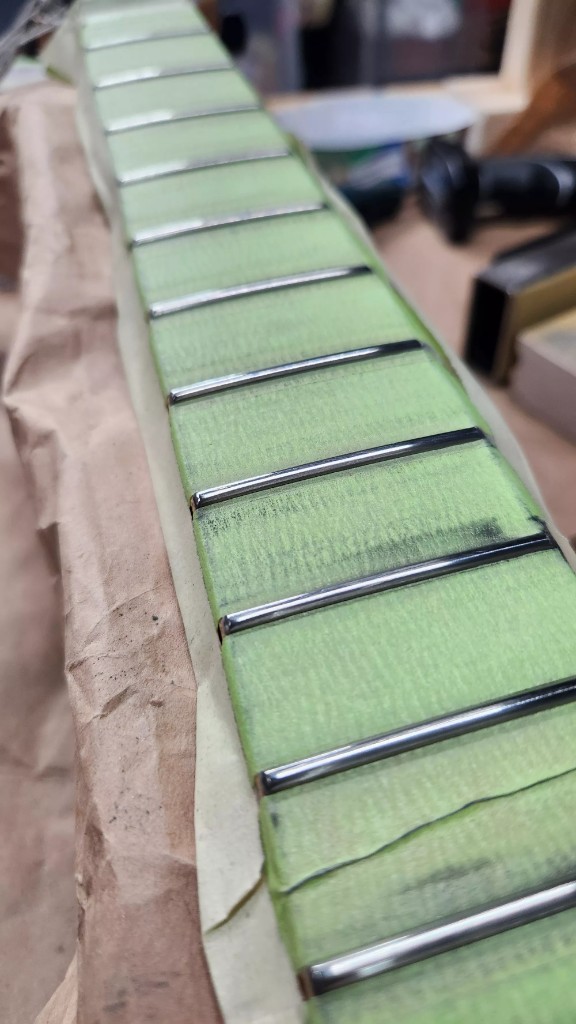
A lot of new guitars under five hundred dollars now advertise stainless steel frets. That used to be a boutique line. Players hear “never wears out” and assume the neck is finished. The material is better at resisting grooves. The factory still has to seat the wire, dress the ends, and get the fret plane honest.
Stainless is a material, not a job
Nickel frets wear where you live on the neck. Stainless holds that wear off much longer. That is the real win. It does not fix a high fret, a loose fret, a cheese-grater end, or a crown that was never shaped. If the wire was hammered in fast and the ends were knocked off with a cheap file, you feel that on day one. The guitar will still feel that way in five years because the metal will not wear itself into shape.
Why the bench job is different
Stainless is roughly twice as hard as nickel-silver. The usual files load up or chatter. Leveling and crowning take diamond tools, more time, and more care around the board. A polish that looks shiny is not the same as a level, crown and polish that restores a consistent contact point. That is why a stainless dress costs more than a nickel dress. You are not paying for a trend. You are paying for tools that can actually cut the wire.
What to bring in, and what not to grind at home
If the sides of the neck catch your hand, if one fret chokes a bend, or if a few notes die while the rest play, that is fretwork. Do not take a Dremel to stainless. Heat can loosen a fret that was never fully seated. Let the guitar sit if it just came out of a box, then have the plane checked. Stainless can be excellent. It still has to be finished like any other fret job.
A guitar that plays cleanly with stainless frets will stay that way a long time. A guitar that shipped with unfinished stainless just locks the factory shortcuts in place.