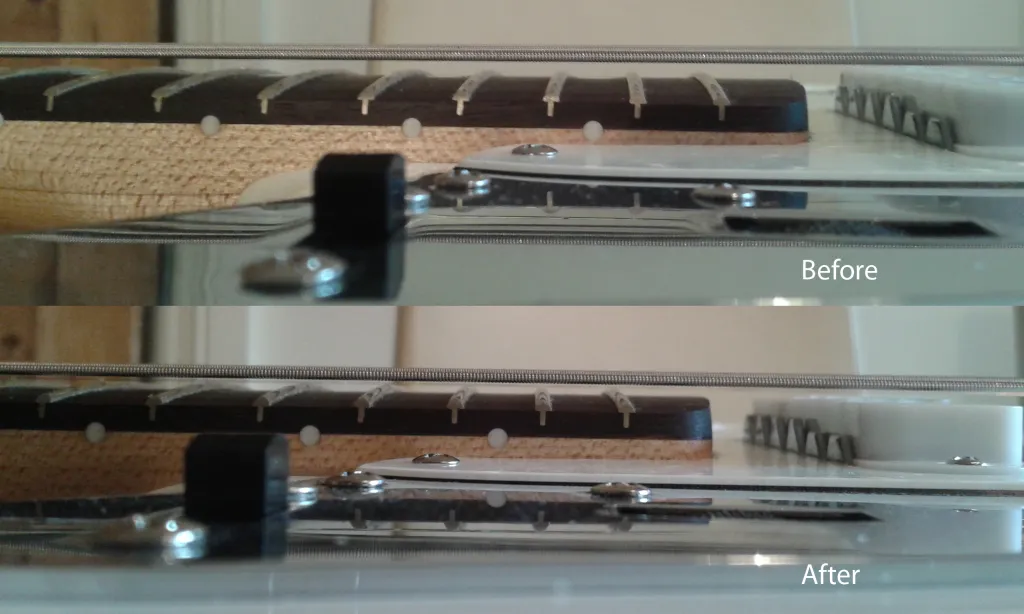
A neck shim has a bad reputation because people have seen bad shims. A scrap of cardboard jammed into a neck pocket is not the same thing as a controlled neck-angle correction.
Neck angle is part of the setup
On a bolt-on guitar, the neck, bridge, saddles, frets, and strings all form one geometry. If the saddles are bottomed out and the action is still too high, or if the saddles are sky-high just to clear the frets, the neck angle may be wrong for that instrument.
A proper shim changes the relationship between the neck and body so the bridge has usable adjustment range again. It does not replace fretwork, nut work, or a setup. It makes those adjustments possible.
Bad shims vs. useful shims
A bad shim creates humps, gaps, instability, or pressure in the wrong place. A useful shim supports the neck pocket correctly and changes angle in a controlled way. The goal is not to hide a problem. The goal is to restore working geometry.
When a shim makes sense
- The saddles are at the end of their travel
- The guitar cannot reach a playable action with normal adjustment
- The bridge design needs a different break angle
- A replacement neck or body does not match the original geometry
- The setup is fighting the hardware instead of using it
On the right guitar, a clean shim is not a shortcut. It is the repair that lets the rest of the setup work properly.