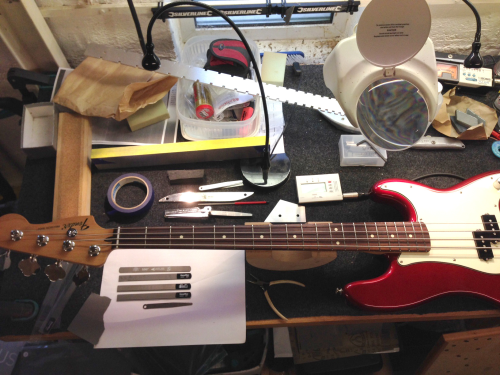
A bass has frets, strings, a truss rod, saddles, pickups, and an output jack. That can make a bass setup look like a guitar setup with four larger strings.
It is not.
The basic geometry is related, but the instrument responds differently under the hands. Longer scale length, heavier strings, wider vibration, lower frequencies, and the player’s attack all change the final result. A number that feels excellent on one bass can feel stiff, noisy, or lifeless on another. A setup that looks impressively low on a ruler may fall apart the moment the player digs in.
The right bass setup is not the lowest possible action. It is the best balance of feel, clarity, consistency, and authority for the player using it.
The string needs room to move
A bass string does not travel in a narrow, polite line between the nut and bridge. It moves in a wide pattern, especially when played hard, tuned down, or amplified with a strong low end.
Lowering the action reduces the clearance available for that movement. At some point, the string begins contacting frets hard enough to change the attack, shorten the note, or add clank and buzz. Some players want a controlled amount of that sound. Others need a cleaner fundamental and more room under the right hand.
Neither preference is automatically wrong.
The setup has to account for where and how the player strikes the string. Playing over the neck creates a different motion from playing close to the bridge. A heavy fingerstyle attack asks for different clearance than a light touch. A pick, slap technique, flatwound strings, roundwound strings, and drop tuning each change the conversation.
Relief is not an action control
Neck relief is the slight forward curve that gives the vibrating string room through the middle of the neck. It is one part of the setup, not a master volume knob for string height.
Too little relief can create buzzing through the lower and middle frets. Too much can make the action feel high in the middle, blur the response, and force the saddles into a bad compromise. Turning the truss rod to lower the strings everywhere may improve one measurement while creating a new problem somewhere else.
A bass setup is a sequence. Relief is evaluated first, then nut height, saddle height, fret condition, and intonation are considered as parts of the same geometry. If one fret is high or a nut slot is wrong, the truss rod should not be used to hide it.
The nut can make a bass feel harder than it is
Players often judge action by looking near the bridge or measuring at the twelfth fret. The first few positions may be telling a different story.
Nut slots that are too high make low-position notes harder to fret and easier to pull sharp. The bass can feel stiff even when the saddle height is reasonable. Chords, double-stops, and first-position lines take more pressure than they should.
Slots that are too low can produce open-string buzz or force the rest of the setup higher to compensate. A poorly cut slot may also pinch the string, interfere with tuning, or sit at the wrong witness point.
The nut is a small part carrying a large responsibility. A setup that ignores it is incomplete.
Pickup height changes more than volume
Bass pickups are not supposed to be raised until every string is as loud as possible.
Pickup height affects output, balance, attack, and sometimes the way the string behaves. The strings do not produce equal energy, and the pickup does not hear every string equally. Fingerboard radius, string type, pole-piece design, playing position, and the player’s touch all influence the final balance.
If one string disappears, the answer may be a careful pickup adjustment. If the low string overwhelms everything, lowering that side can restore definition. Chasing maximum output can create harshness, imbalance, or unwanted magnetic interaction on some instruments.
Pickup height belongs at the end of the physical setup, when the strings, action, and playing style are already known.
Intonation begins after the bass is stable
Intonation is not the first adjustment. It is the final agreement between scale length, string condition, action, relief, and the way the player frets the note.
Old or damaged strings can intonate unpredictably. Changing string gauge or bridge height changes the setup enough that the saddles may need to be reset. Tuning down changes tension and can change relief, feel, and the amount of compensation needed.
Even fretting pressure matters. A player who squeezes hard can push a note sharp, especially with high action or tall frets. Moving the saddle cannot fully correct a technique-and-geometry problem happening at the fretting hand.
Set the bass with the strings, tuning, and playing approach it will actually use. Then intonate it.
Fret noise is not automatically a failed setup
An unplugged bass can sound alarmingly mechanical. The pickups do not reproduce every scrape and click heard by the ear sitting two feet from the fingerboard.
That does not mean all buzz should be ignored. It means the instrument should be judged in context. Is the noise coming through the amp? Does it shorten the note? Does one area of the neck behave differently? Does the sound disappear when the player uses a normal stage attack?
A little acoustic contact may be acceptable in an intentionally low, aggressive setup. A choking note, inconsistent sustain, or buzz isolated to one fret may point to a real geometry or fret problem.
The amp gets a vote. So does the player.
The setup should fit the job
A studio player who wants clean, even notes may need more clearance than a player chasing bright clank and fast response. A reggae player using flatwounds may want a different feel from a metal player tuned down with a pick. A five-string low B needs to speak clearly without forcing the rest of the instrument into an uncomfortable compromise.
Before the bench work begins, the useful questions are simple:
- What tuning do you use?
- What strings and gauge do you prefer?
- Do you play with fingers, a pick, slap, or a mix?
- Where do you strike the strings?
- What feels wrong now?
- Do you want cleaner notes, lower action, more attack, or more room to dig in?
Those answers matter more than copying a factory specification without context.
A bass setup uses measurements, but it is not built for the ruler. It is built for the player, the amplifier, and the part the instrument has to play when the rest of the band arrives.
— Gary
BadMonkey Music — Serving musicians since 1985