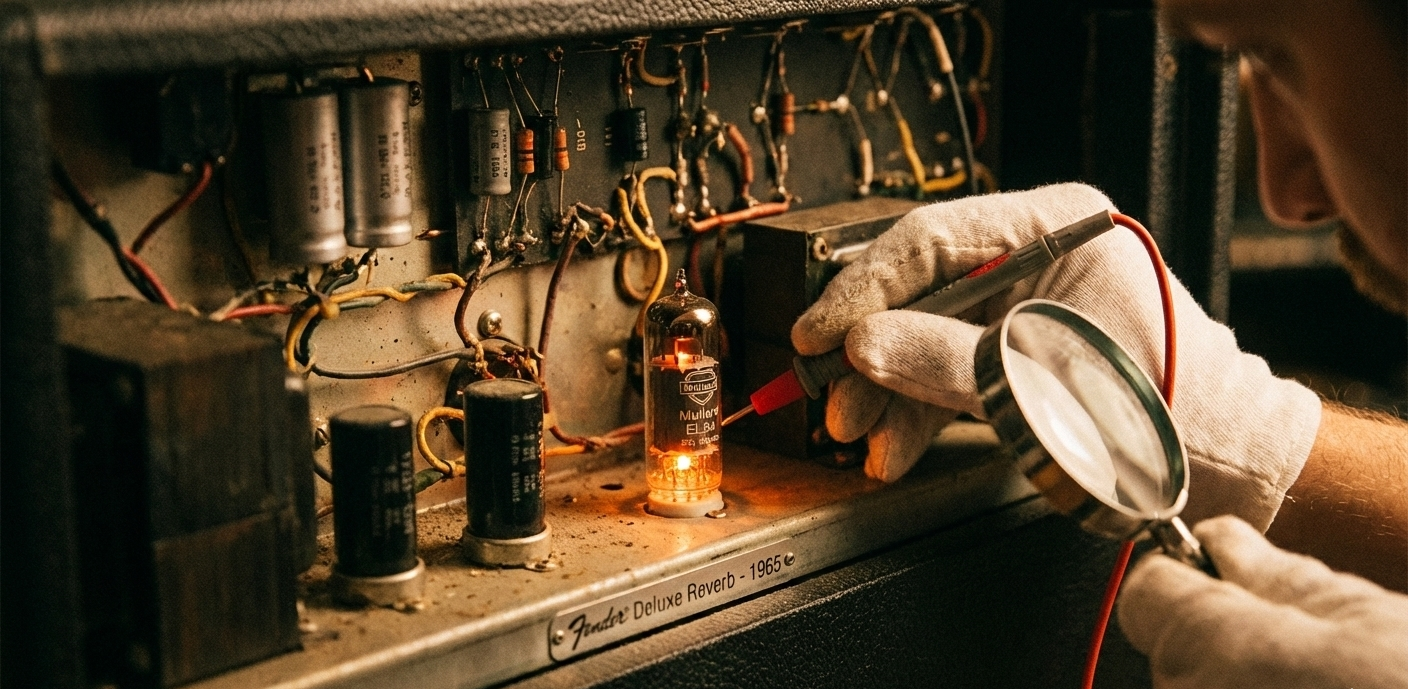
The tubes usually go on trial first.
An amp starts crackling, popping, fading, or making a sound like somebody frying bacon in the next room, and the first diagnosis is often immediate: bad tube. Sometimes that diagnosis is right. Tubes wear, fail, become noisy, and can behave differently after they get hot.
But a tube amp is a complete signal path, not a glass-bottle vending machine. The noise may begin at the guitar, the cable, an input jack, a control, a tube socket, a solder joint, or another component that only misbehaves when heat and vibration enter the picture. Replacing tubes before proving the source can turn diagnosis into an expensive guessing game.
Start outside the amp
Before blaming anything inside the cabinet, simplify the rig.
Plug the guitar straight into the amp with one known-good cable. Remove the pedalboard, wireless system, adapters, extension leads, and anything else that can add another connection. Try a second guitar if one is available. Try a second cable even if the first cable looks perfect.
This is not glamorous troubleshooting, but it is useful. A loose output jack or failing instrument cable can sound exactly like an amplifier problem once the amp makes that bad connection loud. Active guitar and bass electronics can also distort, fade, or crackle when the battery is weak. If moving the instrument cable near the guitar changes the noise, the amp may only be reporting a problem that started upstream.
The fastest repair is the one you do not have to perform.
Listen to what changes the noise
Noise gives clues when you stop treating all noise as the same complaint.
Does the crackle happen with nothing plugged into the amp? Does it change when the volume control is moved? Does tapping the top of the cabinet wake it up? Does the sound appear only after ten or twenty minutes? Does it follow one channel but not another? Does it get louder with the master volume, or stay at the same level?
Those details help place the fault in the signal path.
If turning one control produces scratchiness, the control or the circuitry around it deserves attention. If plugging and unplugging a cable changes the symptom, an input jack or switching contact may be involved. If the amp behaves until it warms up, heat may be changing a weak connection or component. If vibration brings the crackle back, a loose socket, connector, solder joint, or mechanical issue becomes more likely.
None of those clues proves the repair by itself. They narrow the search, which is what good diagnosis is supposed to do.
Why tubes get blamed so quickly
Tubes are visible, replaceable, and famous for failing. That makes them convenient suspects.
A noisy preamp tube can create hiss, crackle, ringing, or intermittent signal. A tube can also become microphonic and react to vibration like an unwanted microphone inside the amp. Power-tube trouble may bring volume loss, distortion, instability, blown fuses, or other symptoms that need proper evaluation.
The problem is that many non-tube faults imitate tube trouble. A tube socket can lose tension. Oxidized contacts can become intermittent. A worn jack can stop making reliable contact. A control can become noisy. Heat can expose a weak solder connection. Replacing the tube may appear to help because the act of removing and reinstalling it disturbed the socket or connection. The noise returns later, and the new tube gets blamed next.
That is how a simple symptom becomes a box full of spare tubes and no real answer.
The warm-up problem matters
An amp that fails after it gets warm is giving valuable information.
Materials expand with heat. Electrical values can drift. A connection that works when cold may become unstable after the chassis reaches operating temperature. The opposite can happen too: an amp may crackle at startup and settle down after warming.
When reporting the problem, include the timeline. “It crackles” is useful. “It begins after fifteen minutes, gets worse when I play a low A, and disappears when I switch channels” is much better.
If possible, note the control settings and whether the amp was played quietly at home or at rehearsal volume. Some faults wait for heat. Others wait for vibration. A bench test that does not recreate the conditions may never hear the complaint.
Safe checks and unsafe curiosity
A player can safely simplify the external signal chain, try known-good cables and instruments, document the controls that affect the symptom, and check the manufacturer’s operating instructions. That information can save real diagnostic time.
Opening a tube amp is different.
Tube amplifiers can contain dangerously high voltage, and stored energy may remain inside even after the amp is switched off and unplugged. The chassis is not a safe place for casual cleaning, probing, tightening, or internet-guided experimenting. An unplugged amp is not automatically a harmless amp.
If the amp smells hot, repeatedly blows a fuse, loses power, shows unusual tube behavior, or makes loud pops followed by silence, stop using it. Do not keep installing larger fuses or repeatedly powering it up to see whether the problem clears its throat.
What to bring to the diagnosis
Bring the amp’s make and model, the exact symptom, how long it takes to appear, and what was connected when it happened. Mention any recent tube replacement, transport, impact, spill, speaker change, or repair. If the amp uses a separate cabinet, include the cabinet and speaker cable details.
A short phone recording can help, especially with an intermittent sound, but it does not replace reproducing the problem. The best description explains when the sound happens and what makes it change.
The goal is not to defend the tubes or accuse the jacks. The goal is to find the first place the signal stops behaving.
A crackling amp may need a tube. It may need a connection repaired, a control serviced, a jack replaced, or a deeper bench evaluation. The honest answer begins after the easy assumptions end.
— Gary
BadMonkey Music — Serving musicians since 1985